How to Make a Wooden Canoe
Paddle
by Bob Gillis
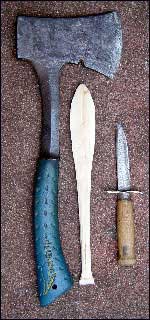 This canoe paddle was first carved
as a model from a section of a willow branch and then an actual
full size paddle was created from a 2" by 6" redwood
board. Choose a light weight wood as you want the finished paddle
to be light in your hands (examples: spruce, pine, cedar, redwod
as lumber or logs).
This canoe paddle was first carved
as a model from a section of a willow branch and then an actual
full size paddle was created from a 2" by 6" redwood
board. Choose a light weight wood as you want the finished paddle
to be light in your hands (examples: spruce, pine, cedar, redwod
as lumber or logs).
Tools used: Knife, hatchet, or
band saw to remove material. If you don't want to use power tools,
like the band saw, then use a hatchet instead. The paint was acrylic.
Other natural earth pigments and minerals could also be used to
color your paddle.
1) Make drawings of what you
want your canoe paddle to look like. If you are looking for reference
on indigenous traditional paddles, go to your local college libraries
or bookstores for photos and drawings.
2) Make a small model of your paddle
to see what it will look like in three dimension.
3) For the full size canoe paddle,
draw an outline on the top and side of your chosen wood.
4) Cut away, with a saw, hatchet,
or band saw, the bulk of your unwanted material.
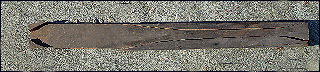
5) Use a hatchet and knife to thin
and shape your paddle.
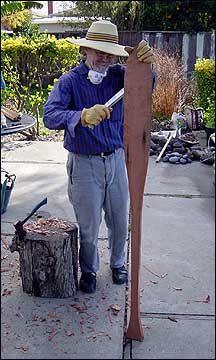
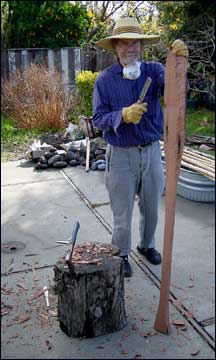
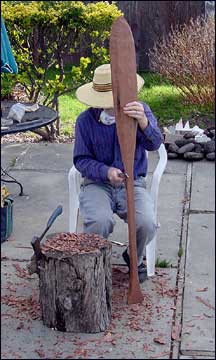
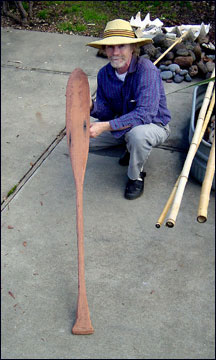
6) If desired, draw onto, carve,
and/or paint your paddle.

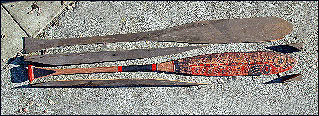
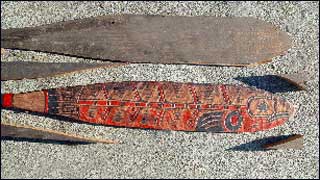
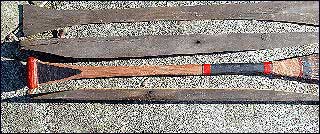
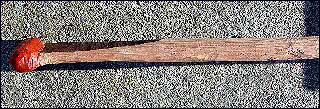
7) Note: The shape of the paddle
where your hands grip is important to the comfort in use.
The upper part that the hand naturally grips is a horizontal bar.
It is about 1.5" in diameter on my paddle. The lower hand
hold should be of a diameter that is comfortable to grip. It is
about 2" in diameter on my paddle.

This is a useful and natural tool for water transportation.
It's also a fun project. Send photos of the paddles you have made
to PrimitiveWays and we will add them to this webpage.

E-mail your comments to "Bob Gillis" at bob@shelter-systems.com
PrimitiveWays
Home Page
We hope the information on the PrimitiveWays website is both instructional and enjoyable. Understand that no warranty or guarantee is included. We expect adults to act responsibly and children to be supervised by a responsible adult. If you use the information on this site to create your own projects or if you try techniques described on PrimitiveWays, behave in accordance with applicable laws, and think about the sustainability of natural resources. Using tools or techniques described on PrimitiveWays can be dangerous with exposure to heavy, sharp or pointed objects, fire, stone tools and hazards present in outdoor settings. Without proper care and caution, or if done incorrectly, there is a risk of property damage, personal injury or even death. So, be advised: Anyone using any information provided on the PrimitiveWays website assumes responsibility for using proper care and caution to protect property, the life, health and safety of himself or herself and all others. He or she expressly assumes all risk of harm or damage to all persons or property proximately caused by the use of this information.
© PrimitiveWays 2013